Notalo › Learn · How to read sheet music › Treble clef notes
Treble clef notes
The treble clef (𝄞, also called the G clef) is the top staff in piano music and the only staff for most singers, flute, violin, guitar and trumpet parts. Here is every note on it, labeled.
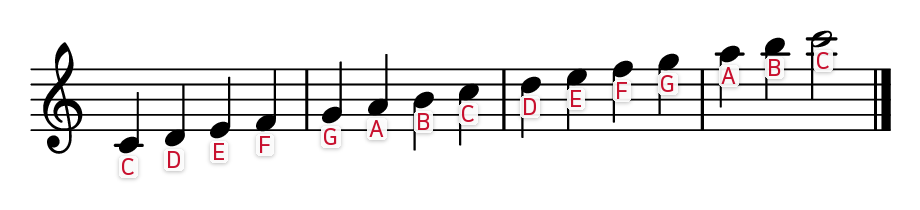
Lines and spaces
| Bottom → top | Mnemonic | |
|---|---|---|
| Lines | E G B D F | Every Good Boy Does Fine |
| Spaces | F A C E | FACE |
The clef's curl wraps around the second line from the bottom — that line is G, which is why it is called the G clef. Every other note follows from there, one letter per step.
Ledger lines
Notes above or below the staff sit on short extra lines called ledger lines. Below the staff: D (just under the bottom line), then middle C on the first ledger line, B, A and so on. Above the staff: G (just over the top line), A on the first ledger line, B, C…
How to read it fast
- Anchor on three notes you know cold: bottom line E, middle line B, top line F.
- From the nearest anchor, count steps: each line-to-space or space-to-line step is the next letter (E F G A B C D E…).
- Watch for a sharp or flat after the clef — the key signature — which changes that letter in every octave.
Octave numbers: which C is middle C?
Letter names repeat every eight notes, so musicians add a number to say which octave they mean. Middle C — the C nearest the middle of a piano keyboard, and the first ledger line below the treble staff — is C4. The notes above it are D4, E4, F4, G4, A4, B4, then the next C is C5. The treble staff covers roughly C4 to C6: the bottom line E is E4, the top line F is F5, and the C on the third space is C5, the one singers call 'high C' in casual talk. You rarely need the numbers to play, but they are useful when a MIDI file or an app tells you a note is 'C5' and you wonder where that is: count up from middle C.
A five-minute practice drill
- Cover the letters on the chart above with a strip of paper and name the five lines bottom to top, then the four spaces. Uncover and check. Repeat until you get nine out of nine three times running.
- Pick any bar of any song on this site — the Twinkle Twinkle page is a good start — cover the red letters, name each note, then uncover to check.
- Play what you named. Saying the letter, seeing it on the staff, and pressing the key at the same moment is what makes the connection stick; reading alone does not.
Common mistakes
- Counting lines from the top. Always count from the bottom line up: E G B D F. Starting from the top gives you the letters backwards.
- Forgetting the key signature. A sharp on the top line F at the start of every staff means every F in the piece is F♯, in every octave, even the low F on the first space. The letter is still F; the key is black.
- Mixing up the clefs. The same position means a different note in the bass clef — the treble's middle line is B, the bass's middle line is D. Check which clef you are on before you name anything.
Reading a real piece? Upload a photo or PDF of any piano sheet music and Notalo writes the letter under every note, so you can play it today and learn the staff as you go.
Add letters to my sheet musicNext: bass clef notes, or back to the full guide on how to read sheet music.
Frequently asked questions
What are the lines of the treble clef?
From the bottom line up: E, G, B, D, F — Every Good Boy Does Fine.
What are the spaces of the treble clef?
From the bottom space up: F, A, C, E — they spell FACE.
Where is middle C on the treble clef?
On a short ledger line just below the staff. The note in the first space above it is D, then E on the bottom line.